Healing in 2026: reflecting and preparing with the Healing House, a spinoff from DBT
You might have heard of the DBT house before. It’s a resource used in Dialectical Behavior Therapy, a type of therapy founded by Marsha Linehan, catered to help those struggling with mental health disorders and emotional regulation. The DBT House is an exercise used to help you determine what triggers you, supports you, and makes you who you are. The ultimate goal of a DBT House is to provide you with a path for mental health recovery, enabling you to reflect on your life, values, emotions, and relationships, and create a path forward towards growth.
Making a DBT house is simple — you draw a house with a foundation, door, walls, roof, and chimney. You can see an example below provided by Charlie Health:
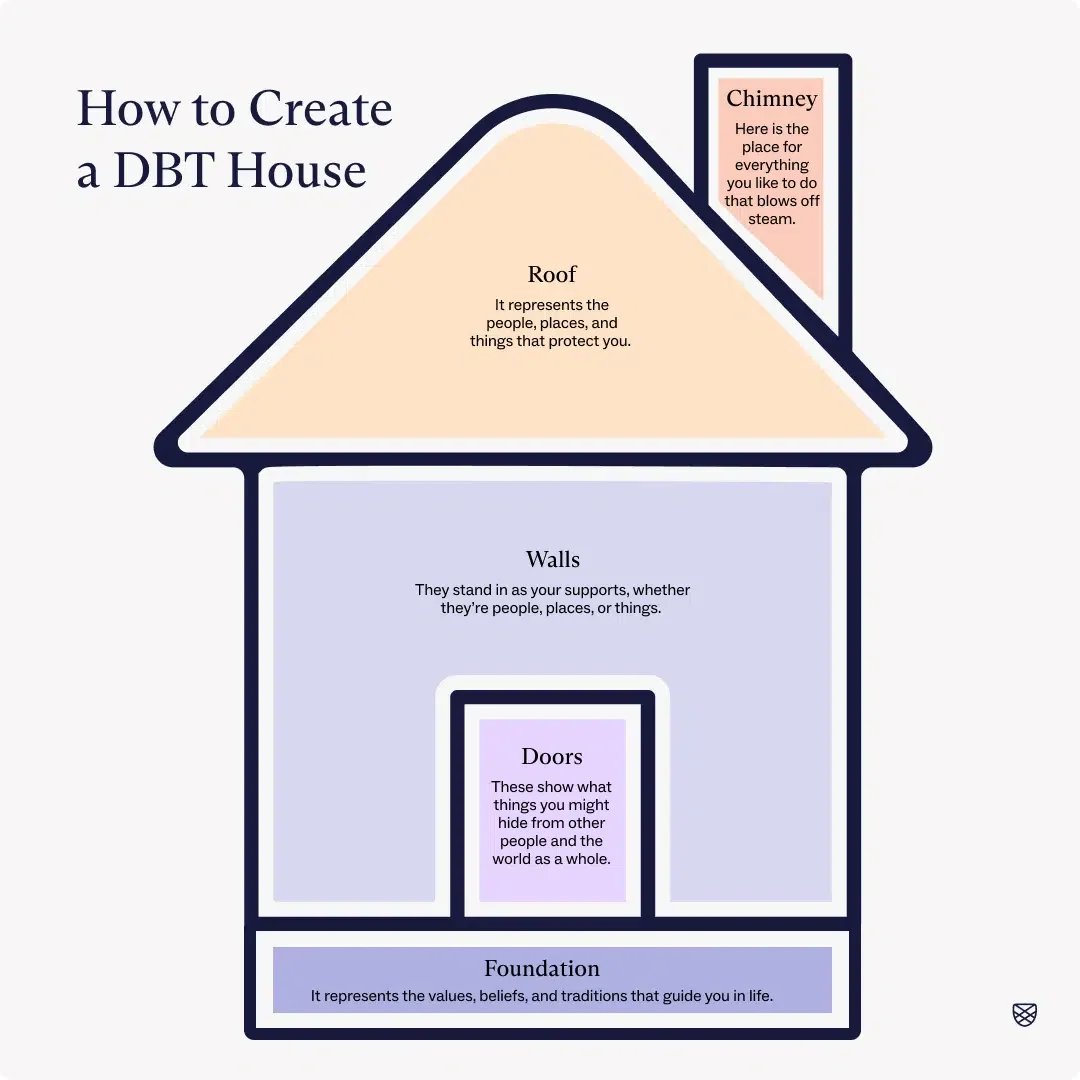
Example of a DBT House:
We are going to use the framework of a DBT House on the left to help us build what we are going to call a Healing House.
A Healing House is similar to a DBT House; however, the functions are different in two distinct ways:
First, a DBT House is a symbolic resource to help you grow in your mental health journey. It doesn’t create an action plan but instead helps you identify where you are, what matters to you, and where you hope to go.
Second, it is a secular resource, meaning that it adheres to no faith values. The foundation of the DBT House, for example, consists of your core values, which differ from person to person.
In contrast, the Healing House is a practical, Christian-based resource. The ultimate goal is to help followers of Jesus create a practical healing plan for their mental health recovery, with Jesus as the foundation of their life. Why do we need Jesus as the foundation? Matthew 7:24-27 explains this to us:
“Therefore, everyone who hears these words of mine and acts on them will be like a wise man who built his house on the rock. The rain fell, the rivers rose, and the winds blew and pounded that house. Yet it didn’t collapse, because its foundation was on the rock. But everyone who hears these words of mine and doesn’t act on them will be like a foolish man who built his house on the sand. The rain fell, the rivers rose, the winds blew and pounded that house, and it collapsed. It collapsed with a great crash.”
Jesus is the only Rock, and therefore the only foundation for our lives that won’t crumble. I know what you’re thinking — but why can’t I be my own foundation? Probably because, like me, you simply aren’t stable enough. It would take something or someone perfect to keep our lives stable through the craziness of everyday life. Only Jesus can provide the stability we need to face every day and anything that comes our way. And He alone will provide the foundation that can help us achieve full freedom. Remember: “Where the Spirit of the Lord is, there is freedom” (Corinthians 3:17).
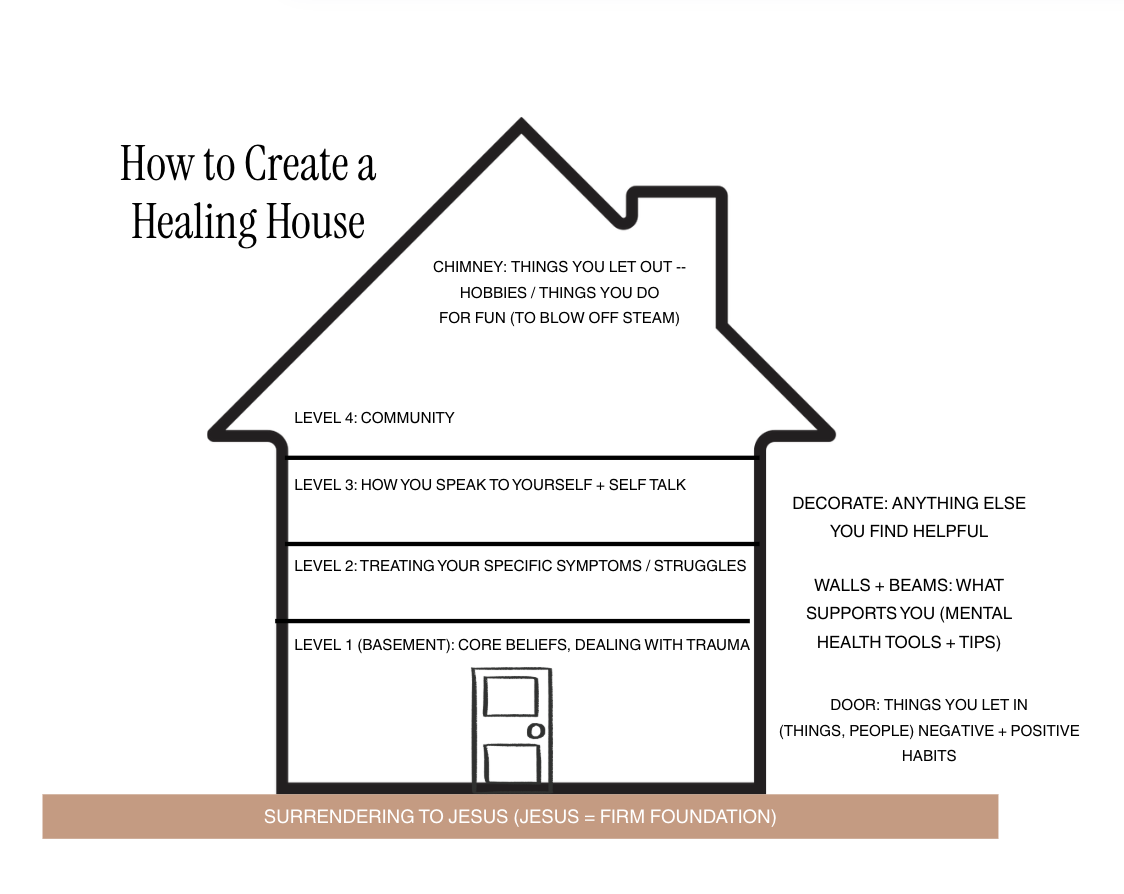
Now that we know Jesus is the Firm Foundation, let’s quickly go through each piece of the Healing House. And remember, the House, just like in Jesus’ parable, is really just YOU: your mind, your struggles, and how you interact with yourself and the world.
Door: What are you letting influence you? It may be things or people that you let into your space. This can also include negative and positive habits that impact you.
Level 1 (Basement) of the House: What core beliefs do you have? What trauma have you faced? This can include “big t Trauma,” like disasters, assault, or sexual abuse, or “little t trauma,” like bullying, divorce, or chronic stress.
Level 2: What specific struggles do you face? Are you diagnosed with a specific mental health illness or disorder, like obsessive-compulsive disorder, depression, generalized anxiety, or a personality disorder? If you don’t know, do not self-diagnose. Simply list symptoms in this level. If helpful, you can read this article provided by the Cleveland Clinic on Types, Causes, and Symptoms of Mental Health Disorders.
Level 3: How do you speak to yourself? This includes internal self-talk. Are you noticing any negative patterns in the way you speak to yourself?
Level 4: Do you have a good community? Do you have people who are supportive, who understand what you’re going through, and who you can rely on?
Walls + Beams: Things that support you. Here, you will write out any tools you’ve learned that have supported you on your mental health journey so far. You can always add or take away from this list.
Chimney: What hobbies or passions do you pursue to let off steam? Or, what do you do to soothe yourself? You can include any self-care items here.
Finally, add Decor. Everyone furnishes their house differently. You may find that adding certain things to your life helps you be the best you. Maybe this is a certain routine, personal style, meal plan, volunteerism, whatever it is that helps you in your mental health journey.
Now that you know how to make a Healing House, this is what you do once you fill it out: CREATE A PLAN.
This resource is so helpful for reflection and provides you with helpful insights about yourself. But if you don’t do anything with this information, none of it really matters. I know that sounds harsh, but I mean it in a tough love type of way!
After completing your Healing House, fill out a plan to address each category. I’ll provide examples of some options below:
Door: Set boundaries with people from whom you need space. Celebrate your positive habits and make a plan for addressing negative ones slowly, over time. If negative habits are rooted in deeper things like a mental health disorder or trauma, continue to Level 1.
Level 1 (Basement) of the House: Talk to a trauma therapist or do EMDR therapy. Find books on trauma and how to work through negative core beliefs.
Level 2: Go to a psychiatrist, psychologist, doctor, or licensed therapist to complete a mental health assessment. Mental health assessments are also available online. Once a diagnosis is clear, get specific treatment for that diagnosis by speaking with a mental health counselor or joining programs. Speak with a psychiatrist if medication support may be needed.
Level 3: Replace every negative thought with a positive one. Say “STOP” out loud every time you catch yourself speaking negatively to yourself. Have a list of affirmations you read over yourself daily.
Level 4: Join an online or in-person support group. Open up to a family member or friend who may understand what you’re going through. Join groups where people are interested in the same things as you are.
Walls + Beams: Emotional Regulation, TIPS (DBT tool), Cognitive Reframing, Naming Cognitive Dissonances, Somatic Therapy, Horse Therapy
Chimney: Comfort shows, reading, pursuing my purpose, painting, spending time with Jesus
Decor (Extra Stuff): wear comfy clothes because they make me feel good, have a morning routine with my Bible and coffee, have a meal plan of 3 meals and 2 snacks a day, get a personal style that makes me feel more like myself, get an emotional support dog
I hope that reading more about how to build your own Healing House helped you. Especially as we go into the New Year, I hope you can reflect and prepare for the year ahead!